
Cook County Address History Sources
Cook County previous residents appear in sources made for different purposes. Clerk recordings follow title events, the parcel map preserves geography, directories freeze a name and address in one publication year, and census schedules show a household on one count date. Start with the era in question, but keep the current Property Index Number, or PIN, close at hand. It is the strongest link among the Assessor card, parcel map, tax portal, and modern deed index. For an old Chicago address, the street number may need conversion before any name search works.
| Historical source | Documented span | Custodian | Best evidence |
|---|---|---|---|
| Clerk online recordings | 1985 to present | Cook County Clerk CRS | Grantor, grantee, PIN, legal description, and deed dates |
| Archived parcel layer | 2000 to 2023 | CookViewer GIS | Earlier parcel shapes and mapped context, not a full owner list |
| Chicago city directories | 1839 to present collection span | CHM, CPL, Newberry | Dated names and addresses, with gaps between runs |
| Chicago criss-cross volumes | Selected mid-century years | CPL and Newberry | Address-first snapshots of listed occupants |
| Building permits | 1872 to 1954 historical collections | CHM and UIC; later records through Chicago | Build and alteration dates, applicants, and address evidence |
| Sanborn fire maps | 1894 to 1897 and 1905 to 1951 at CPL | CPL, Newberry, LOC, UIC | Building footprint, material, and use, not proof of occupants |
| Federal census | 1790 to 1950 public schedules | NARA and library databases | A household snapshot on the enumeration date |
| Court and vital indexes | Varies by division and record type | Circuit Court Archives, Clerk, State Archives | Heirs, relatives, death or marriage leads, and case events |
For a recent transfer, begin with the official recordings index. For the years before its online cutoff, take the legal description to the Clerk's older tract-book route, then use maps and directories to reconcile the street wording. The Cook County city directory collections deserve a separate visit when the goal is to interpret publishers, abbreviations, and missing years. They support the address trail here without replacing title evidence.
Start Cook County History With PIN
The current street label is only a map clue. Open the Cook County Assessor address search, copy the 14-digit PIN, and save the property location, class, township or neighborhood, and any useful card details. The Assessor warns that its Property Location field is not a legal or postal mailing address. That warning matters when tracing past residents because a clean-looking address can still be a weak match.
The property-information record adds the legal description, mailing address associated with the parcel, five years of tax and exemption history, and recent recorded-document summaries. Those fields can point toward a deed, but they do not replace the recorded image. Condominiums, parcel splits, and recombinations may also place more than one PIN behind one postal address. Save each PIN before walking backward.
The Assessor's sample parcel card shows how Cook County labels values, classification, history, and the mailing-address caution.
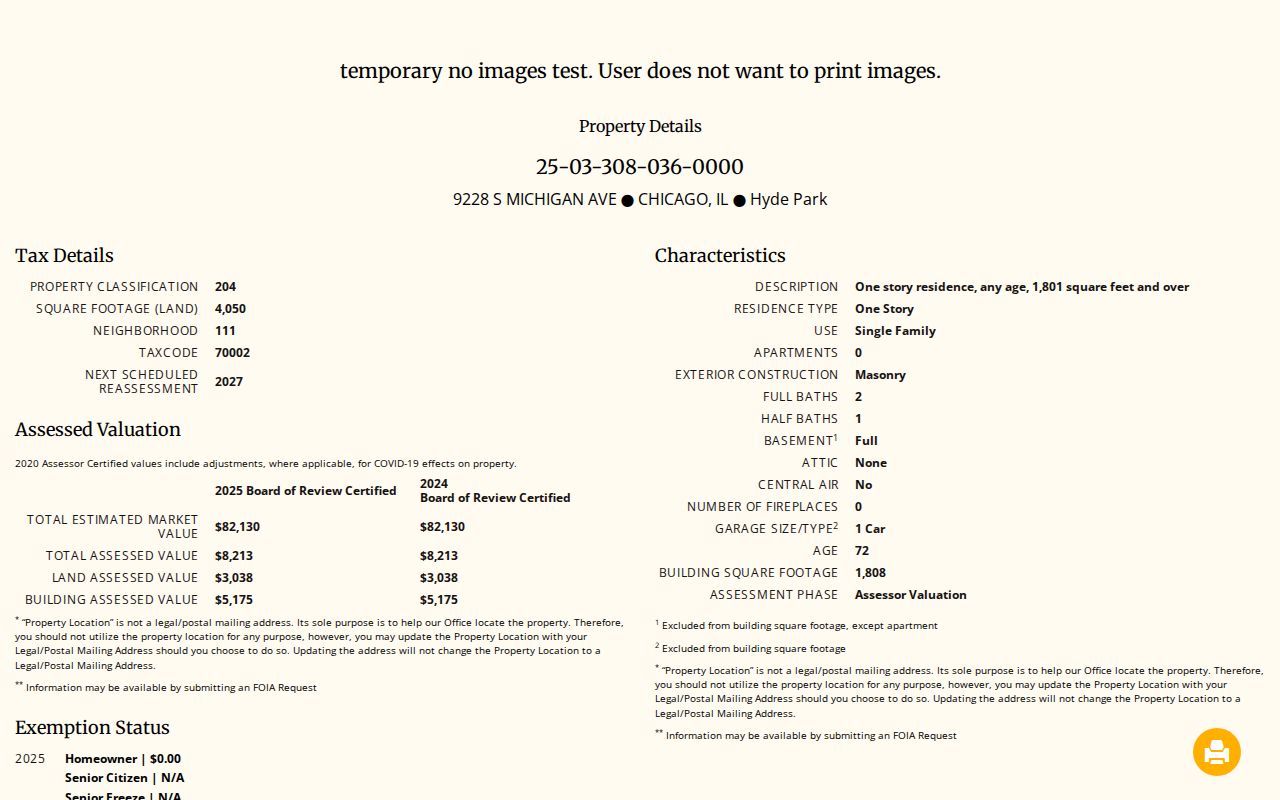
The card is a starting record for the parcel, not proof of every past or present person who lived there.
Trace Cook County Previous Owners
The Cook County Clerk's Recordings System is the official modern index for the deed chain. The documented online span begins in 1985, and the inspected page reported documents indexed through August 6, 2026. Search by PIN when possible. Then open the newest deed-like item and follow its parties backward. A grantor gives property away or sells it; a grantee receives it. Trusts, initials, spouses, and name variants make a name-only trail risky.
- Copy the current PIN and legal description from the parcel and property-information records.
- Search that PIN in CRS and open the newest deed or transfer record.
- Record the grantee, grantor, document number, execution date, recording date, and legal description.
- Search the seller as an earlier grantee, while keeping the same PIN or legal description.
- Repeat to the online cutoff, then ask the Clerk about tract books and older deed books.
- Grantor and grantee
- The party transferring an interest and the party receiving it.
- Chain of title
- The linked series of recorded transfers for the same land.
- Legal description
- The lot, block, subdivision, section, township, range, or condo description that identifies land more firmly than a postal label.
The result may also show consideration, pages, trust numbers, property type, lot, block, unit, and linked image controls. A mortgage, lien, release, or foreclosure notice can explain a title event but does not prove that a person moved. The deed records a conveyance. Occupancy needs a separate dated source.
The Clerk recordings index displays the public search route used to connect PINs and recorded parties.
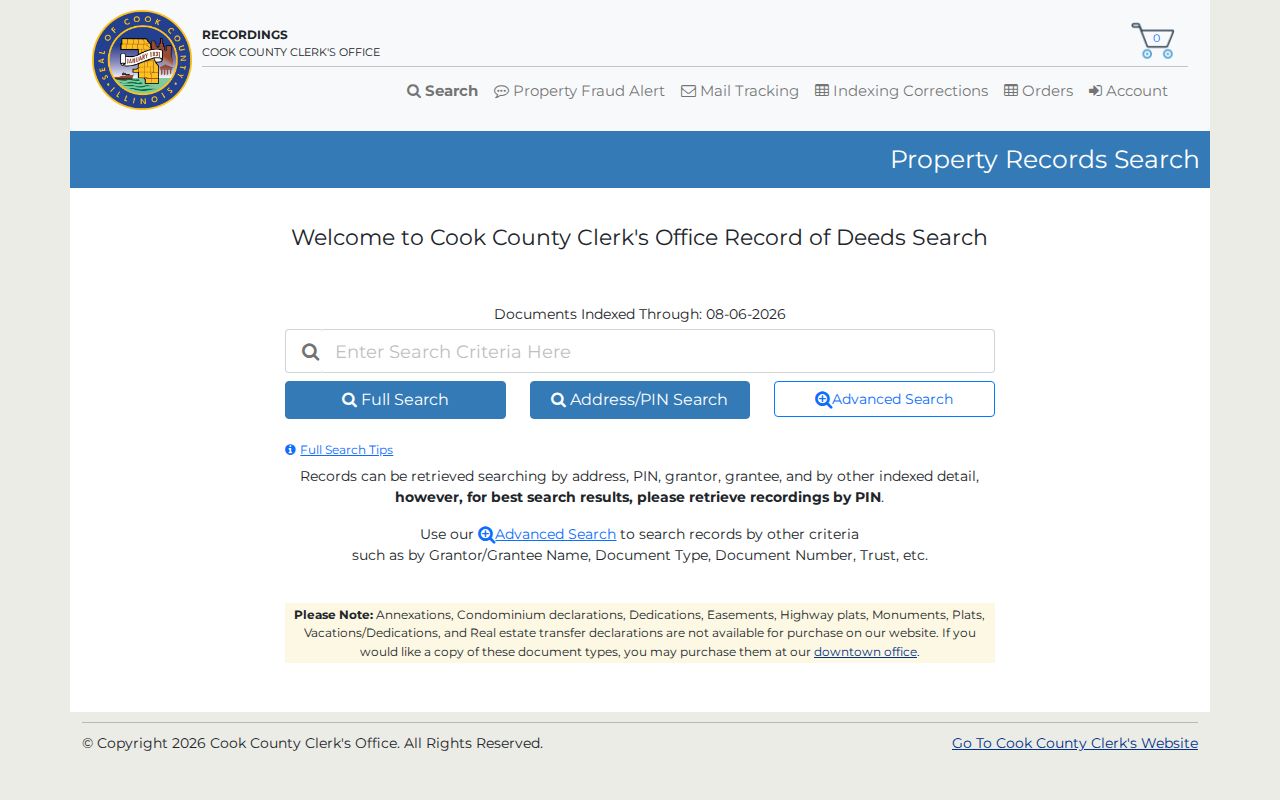
Its index controls lead to images and orders, while a certified document remains a separate product.
The CRS advanced search separates grantor and grantee roles, dates, document types, trust numbers, and legal-description fields.
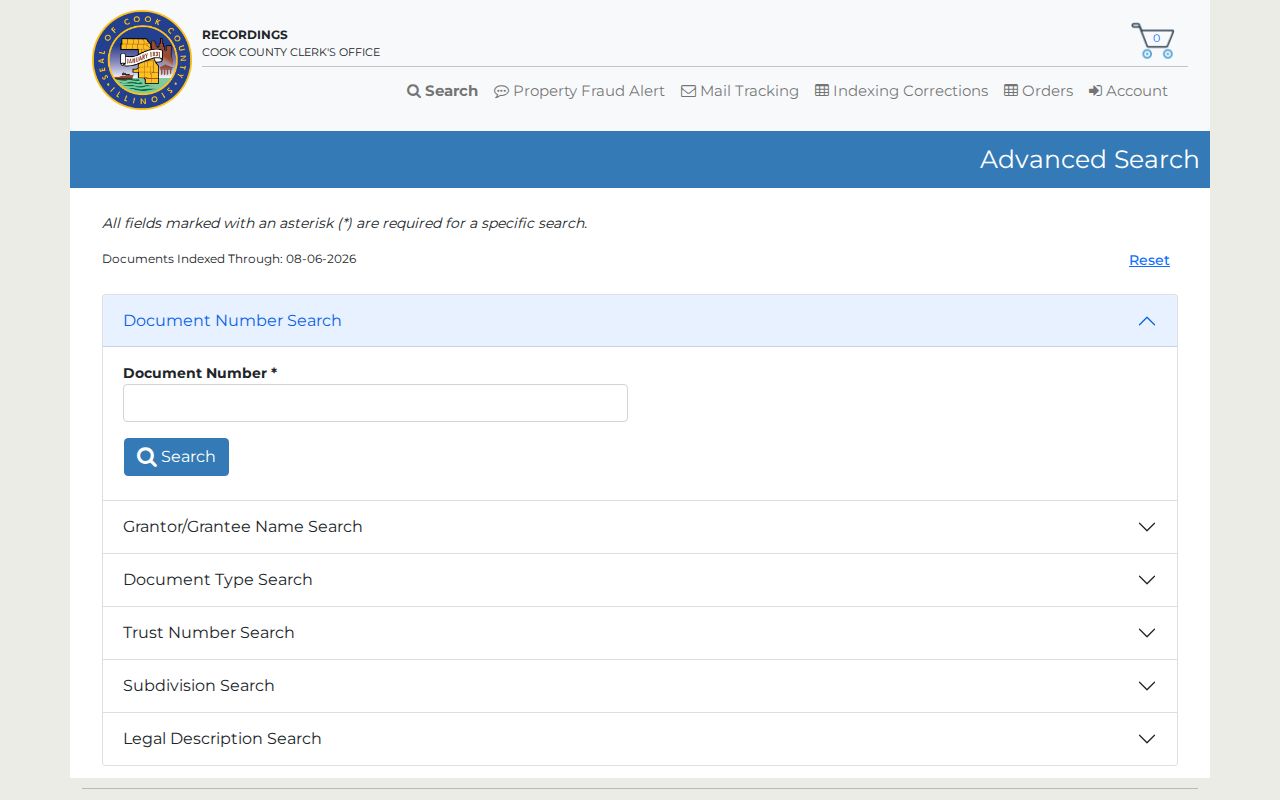
That separation is what makes a backward chain more reliable than a broad surname search.
Cook County's 1985 Record Cutoff
The move of Recorder of Deeds duties into the Cook County Clerk on December 7, 2020 is a custodian change, not a reset of land records. The online CRS index still has a documented 1985 start. Earlier title work therefore moves from a web search to tract books, deed books, legal descriptions, the Clerk counter or recording helpdesk, and archive or library support.
Take section, township, range, subdivision, lot, and block to that fallback search. These terms often survive renaming and renumbering better than the street label. The County Archives page says its reading room is currently closed and provides remote reference, while real-estate questions route to the Clerk. Illinois FOIA can request an otherwise public administrative record, but it does not replace the Clerk's title index.
Note: A blank online result before 1985 usually marks an access boundary, not proof that Cook County has no earlier record.
Old Chicago Numbers Hide Residents
Chicago changed street numbers in 1909, and the Loop followed in 1911. A person listed at an old number can seem to vanish when that number is entered into a modern map. The Chicago History Museum house-history method recommends an old-to-new conversion list, a directory street guide, corner or intersection searches, permits, maps, photos, and neighborhood history sources.
Preserve both forms of the address. Search the old street name, nearby numbers, the intersection, city section, and subdivision. Then reconnect the historic site to a modern PIN. Annexations and renamed streets can create the same trap elsewhere in Cook County, whose current landscape includes 134 municipalities and unincorporated pockets.
Key check. Match a pre-conversion address through the street guide and legal description before assigning previous residents to today's parcel.
Cook County Maps Date Buildings
Maps and permits answer a different question from deeds: was the same structure present when a listed household used the address? Chicago permit ledgers begin in 1872. The 1912 to 1955 indexed books are more complete than the 1872 to 1911 ledgers, and later material routes through the city building department or a records request. Permit evidence may name an applicant and describe work, but it does not list every occupant.
The Chicago Public Library Sanborn index covers map sets from 1894 to 1897 and 1905 to 1951.
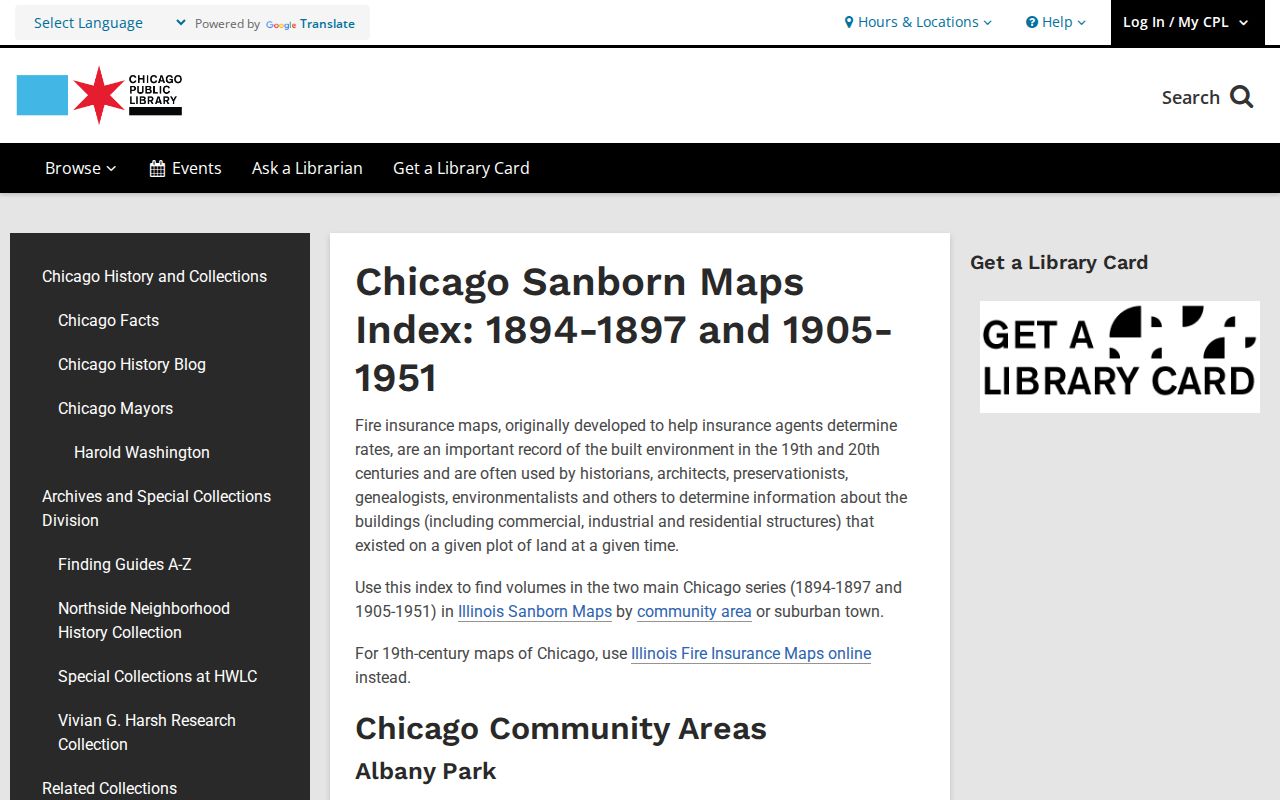
Compare footprints, materials, and use across editions, then return to directories or census records for people. Newberry's documented Sanborn run supplies another map route for 1900 to 1950.
Cook County Past Household Evidence
Owners are only half the story. A traditional directory can tie a named householder to an address in one publication year, while a criss-cross directory starts with the address and lists the entry found there. A federal census can show the people counted together, their relationships, ages, and other recorded facts on one enumeration date. None should be treated as an annual occupancy log.
- Choose a directory year closest to the title or permit event and save the full entry.
- Check the address-first criss-cross volume where one exists, noting the publication year.
- Open the nearest public census schedule and confirm the address, ward or enumeration district, and household names.
- Compare names with marriage, death, obituary, cemetery, or probate evidence, and mark gaps rather than filling them by guess.
An enumeration district is the area assigned to one census taker. Its boundary can help locate a household when the street index fails. Cook County probate and will archives cover 1871 to 1975 in the published division schedule; older death and marriage indexes also provide relatives and date leads. The 1871 Great Chicago Fire destroyed many pre-fire marriage licenses, so newspaper and Fink index evidence may be the bridge rather than the lost original.
Lawful use. Research Cook County previous residents for house history, genealogy, or estate work. Never use a record trail to track, threaten, or harass a living person.
When Cook County Trails Go Offline
A sound fallback chain starts with the record custodian. Ask the Clerk Recordings division about older tract and deed books, use the court archive request for probate or other indexed files, and consult CPL, Chicago History Museum, Newberry, the Illinois State Archives, or IRAD for directories, maps, newspapers, and historical indexes. Public library databases may require a card, while archive materials may need advance retrieval.
Keep a research log with the address form used, PIN, legal description, source title, year, page or document number, custodian, and search date. Mark a name as a recorded party, taxpayer mailing contact, directory entry, census household member, or obituary subject. Those labels prevent a plausible link from becoming an unsupported claim about who lived here before.